


Pneumatic Valve Actuators
Why Choose Us
Zhejiang Maikailun Automatic Control Valve Co., Ltd is a well recognized world leader and reliable manufacturer for pneumatic actuator and pneumatic valve in China. With over 20 years innovation and extensive industry experience, Maikailun provides first class products and services for customers worldwide.
Wide Product Range
Maikailun supplies pneumatic actuators and valve control accessories such as manual override, limit switch box, solenoid valve, filter regulator, valve position feedback device etc.
Provide Solutions
Maikailun provides professional valve automation solutions like pneumatic ball valve, pneumatic butterfly valve etc. for diverse applications.
Quality Assurance
Our actuator ranges from Φ32~Φ400mm, torque covers from5Nm to 50000Nm.
Quick Response
Our commitment is to respond to your inquiries within 24 hours, ensuring that you receive the information and support you require in a timely manner.
-
![Pneumatic Ball Valve Actuator]() Pneumatic Ball Valve ActuatorPneumatic ball valve is a ball valve with a pneumatic actuator, the execution speed of the pneumatic actuator is relatively fast, the fastest switching speed is 0.05 seconds / time, so it is...read more
Pneumatic Ball Valve ActuatorPneumatic ball valve is a ball valve with a pneumatic actuator, the execution speed of the pneumatic actuator is relatively fast, the fastest switching speed is 0.05 seconds / time, so it is...read more -
![Pneumatic Butterfly Valve Actuator]() Pneumatic Butterfly Valve ActuatorThe pneumatic butterfly valve is composed of a combination of pneumatic actuator and butterfly valve, because of the characteristics of the butterfly valve, such as light weight, simple structure,...read more
Pneumatic Butterfly Valve ActuatorThe pneumatic butterfly valve is composed of a combination of pneumatic actuator and butterfly valve, because of the characteristics of the butterfly valve, such as light weight, simple structure,...read more -
![Pneumatic Ptfe Lined Plug Valve]() Pneumatic Ptfe Lined Plug ValveA pneumatic PTFE lined plug valve is a type of valve that uses compressed air or gas pressure to regulate the opening and closing of a plug mechanism, which is coated with PTFE material.read more
Pneumatic Ptfe Lined Plug ValveA pneumatic PTFE lined plug valve is a type of valve that uses compressed air or gas pressure to regulate the opening and closing of a plug mechanism, which is coated with PTFE material.read more -
![Pneumatic Three-way High Ball Valve]() Pneumatic Three-way High Ball ValveThe pneumatic high-pressure ball valve adopts a three-stage valve body, which makes the structure more compact and easy to assemble, and is suitable for hydraulic oil, water, high-pressure gas and...read more
Pneumatic Three-way High Ball ValveThe pneumatic high-pressure ball valve adopts a three-stage valve body, which makes the structure more compact and easy to assemble, and is suitable for hydraulic oil, water, high-pressure gas and...read more -
![Pneumatic Three-piece Ball Valve]() Pneumatic Three-piece Ball ValveThe pneumatic three-piece ball valve is an evolution of the globe valve. It has the same rotational 90-degree lifting action, except that the body is a sphere with a circular through hole or...read more
Pneumatic Three-piece Ball ValveThe pneumatic three-piece ball valve is an evolution of the globe valve. It has the same rotational 90-degree lifting action, except that the body is a sphere with a circular through hole or...read more -
![Double Flange Pneumatic Knife Gate Valve]() Double Flange Pneumatic Knife Gate ValvePneumatic knife gate valve is a kind of valve that uses pneumatic actuators to control the valve, so as to realize the opening and closing of the valve. It can be divided into two parts, the upper...read more
Double Flange Pneumatic Knife Gate ValvePneumatic knife gate valve is a kind of valve that uses pneumatic actuators to control the valve, so as to realize the opening and closing of the valve. It can be divided into two parts, the upper...read more -
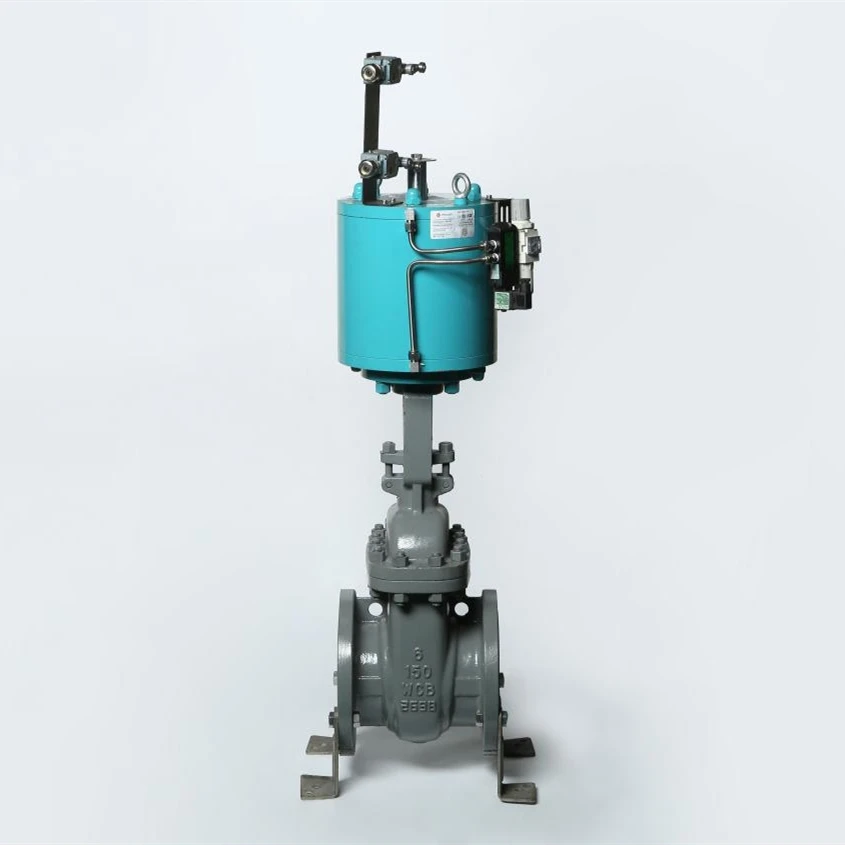
![Pneumatic Control Valve]() Pneumatic Control ValveThis pneumatic control valve comes with high performance WCB and SS304 material, which has longer service life to use. In addition, the parts material is made from top quality stainless steel 304...read more
Pneumatic Control ValveThis pneumatic control valve comes with high performance WCB and SS304 material, which has longer service life to use. In addition, the parts material is made from top quality stainless steel 304...read more


High Force & Speed Of Movement
Pneumatic actuators can deliver high force and fast speeds of movement when used in linear motion control applications.
High Durability
Overheating is not a problem of concern with pneumatic actuators, regardless of how excessive the use of the application is. These devices can sustain constant pressures in comparison to alternative devices and therefore offer a longer-term of use.
High Reliability
The pneumatic actuator largely to the high control that can be maintained on the conversion of gas to energy. They are highly durable means that performance is of a high standard and these devices have a long life span.
Clean Technology
Pneumatic actuators are down to the use of air as opposed to fluid, with the compressed air being free from harmful chemicals, therefore protecting the application from contamination.
Cost Effective
Thanks in part to the fact that it is easy to install and maintain, the pneumatic actuator is often seen as the cost-effective choice when it comes to industrial applications.
High Quality Pneumatic Actuators
Their range includes electric, grippers, guided, linear, rodless, rotary and speciality actuators.

Single-Acting Pneumatic Actuator
A single-acting pneumatic actuator, or a spring-return actuator, operates by opening the valve with air and closing it with a mechanical spring (or springs).
Double Acting Pneumatic Actuator
Double-acting actuators are preferred for their reduced cost and longer lifespan since the lack of mechanical springs in most variants eliminates the actuator's least durable component. It is not unusual for high-quality double-acting actuators to go millions of cycles before failing.
Rotary Pneumatic Actuator
The rotary gear type pneumatic actuator operates similarly to a piston pneumatic actuator, with two pressured chambers. A paddle with an output shaft simply separates the two pressure chambers.
Spring/ Diaphragm Pneumatic Actuator
This type of pneumatic actuator uses compressed air to thrust a diaphragm against a plate that is opposed by a spring. Once the pressure is decreased, the spring will pull the diaphragm back.
Piston Pneumatic Actuator
The piston movement can be caused by simply applying less or more power to one side of the piston-style pneumatic actuator applying air pressure to both sides of the piston. The piston's linear motion can be used directly to actuate linear motion or converted to rotational motion using a pinion and rack or a similar mechanical arrangement.
Pick-and-Place & Packaging
Linear and rotary motion can be dually needed, and so both actuator designs may be implemented in one pick-and-place application.
Clamping & Stamping
Pneumatic actuators are used in clamping and stamping applications to operate jaws holding products or marking an object.
Hazardous Applications
Pneumatic actuators are often used to open and close valves, therefore controlling the flow of liquids such as chemicals.
Food & Beverage Applications
Unlike hydraulic systems, pneumatic systems aren't as prone to leaking. For this reason, they are considered advantageous for applications where contamination is a concern. As such, food handling applications may deploy pneumatic actuators over other varieties.
Robotic Applications
Robotic applications utilize actuators to create motion in wheels, clamps, and robot appendages.Grippers offer angular motion making them ideal for robotic arm applications.
Frequently Asked Questions
As one of the most professional pneumatic valve actuators manufacturers and suppliers in China, we're featured by quality products and low price. Please rest assured to buy high-grade pneumatic valve actuators in stock here from our factory.
Pneumatic Ball Valve Actuator, Double Flange Pneumatic Knife Gate Valve, Pneumatic Three Way High Ball Valve